
Article by:
Marita Moaje
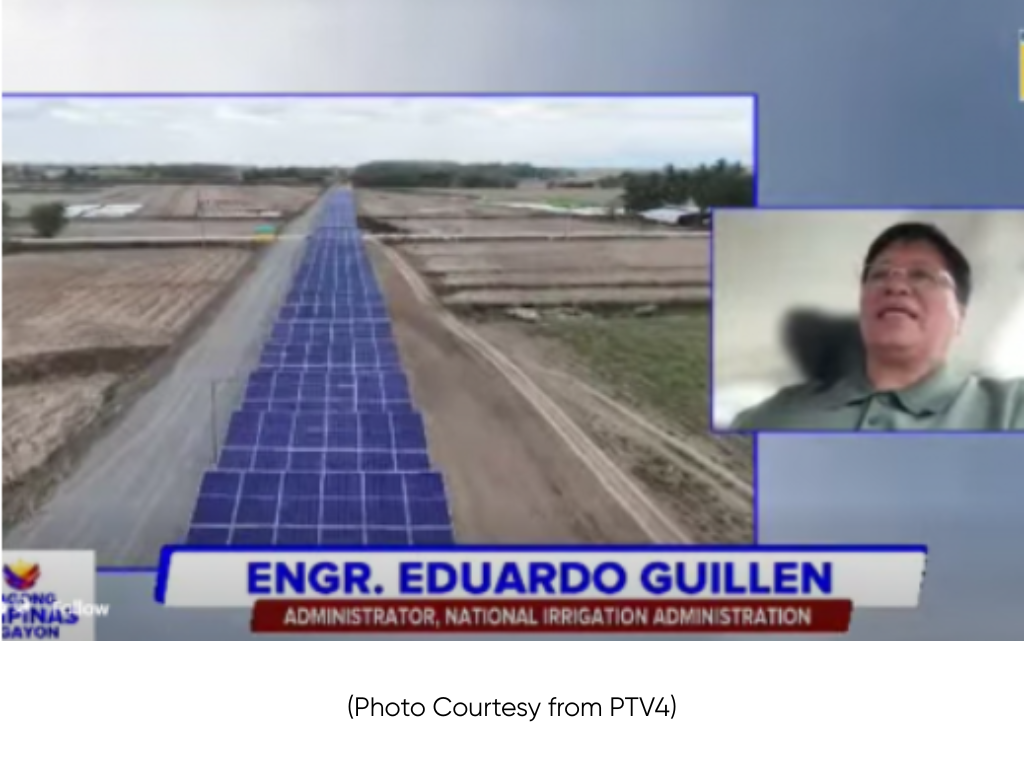
MANILA – National Irrigation Administration (NIA) Administrator Eduardo Guillen on Wednesday said building additional solar pump irrigation projects would mitigate the impact of the oil price surge amid the Middle East crisis on the farmers, who still rely on diesel-powered pumps.
“Dagdagan sana natin iyong mga solar pump irrigation projects natin dahil, alam ninyo, ito po iyong pang-medium-term natin na solution. Mabilis kasing itayo po iyong mga solar pumps natin (Let's increase our solar pump irrigation projects because, you know, this is our medium-term solution. It’s faster to build those solar pumps),” Guillen said during the Bagong Pilipinas interview over PTV4.
Guillen said the NIA has so far constructed almost 3,000 units of solar pumps for irrigation, covering around 30,000 hectares of farmland nationwide.
“Ilang taon na po tayong nagpapatupad ng mga projects tulad ng solar pump irrigation system (We have been implementing projects like the solar pump irrigation system for several years now),” he said. “Kaya medyo marami-rami na rin po (So it's quite a lot already).”
He said NIA has two large projects in Camarines Sur: the Mataoroc-Sagrada-San Jose-Baliuag Agrarian Reform Cooperative (MASSBA) covering 1,200 hectares, and the San Agustin San Ramon Agrarian Reform Farmers’ Cooperative (SARFC) Solar Pump Irrigation Project, which covers 600 hectares.
Aside from these areas, he noted other large solar pump irrigation projects in Cabaruan, Isabela, and Leyte expected to be completed this year.
Guillen said the shift to solar irrigation is complemented by climate-smart technologies that help improve water management and reduce costs through its weather forecasting tools that guide dam operations and irrigation scheduling.
Guillen said the alternate wetting and drying technology of NIA saves the agency around 30 percent on irrigation.
“Dati-rati kasi kapag nagpapatubig ang mga farmers natin, aba, binabaha lagi itong ating palayan. Pero ngayon hindi na po, alternate wetting and drying technology nga at ito po ay isang form din ng carbon credit sequestration (Because before, when our farmers irrigated, our rice fields would always get flooded. But now, it's no longer the case; we use the alternate wetting and drying technology, which is also a form of carbon credit sequestration, so those are the benefits),” he said.
He added that water-saving techniques such as alternate wetting and drying, along with adjustments in the cropping calendar from December to October, have helped farmers cut water use and improve earnings.
More high dams
Aside from solar pump irrigation projects, Guillen said constructing more high dams would boost the water supply for the irrigation system.
“But, again, kung gusto natin na talagang sustainable na solution diyan at pang-long term, magtayo po tayo ng mga high dams (If we want a truly sustainable and long-term solution, let's build high dams),” he said.
He said the target of the NIA is to build dams in 18 major river basins. (PNA)
 Log in with Google