
Article by:
Anna Leah Gonzales
MANILA – The Middle East conflict is expected to weigh on the growth outlook of Asia-Pacific economies, including the Philippines, the Asian Development Bank (ADB) said.
In its April 2026 Asian Development Outlook (ADO) released Friday, the ADB trimmed its Philippine economic growth forecast to 4.4 percent for 2026 from its earlier projection of 5.3 percent.
Economic growth is expected to pick up to 5.5 percent in 2027.
The ADB said domestic demand will continue to drive growth, though at a subdued pace, while business sentiment is likely to remain cautious amid uncertainty stemming from the Middle East situation.
Potential disruptions to remittances from overseas Filipinos, tighter financial conditions, and weaker investor and consumer confidence are also seen to dampen growth. Remittances, however, are expected to recover once conditions in the region stabilize.
The report noted that structural reforms — including amendments to the Foreign Investors' Long-Term Lease Act, the Open Access in Data Transmission Act, the CREATE MORE Act, and green lane initiatives — are expanding opportunities for foreign investment.
It added that effective implementation of these reforms, along with sustained improvements in regulatory processes, should help support investment.
Public infrastructure spending is projected to rebound on the back of improved budget execution, while the government’s fiscal program remains anchored on consolidation under its medium-term framework.
Inflation is forecast to accelerate to 4 percent in 2026 from 1.7 percent in 2025, driven by elevated global commodity prices.
"The Philippine economy, with its heavy dependence on imported fuel, will face challenges from rising external risks," ADB Philippines Country Director Andrew Jeffries said in a statement.
The ADB noted that inflation averaged a relatively low 2.2 percent in the first two months of 2026 but surged in March following the escalation of the Middle East conflict.
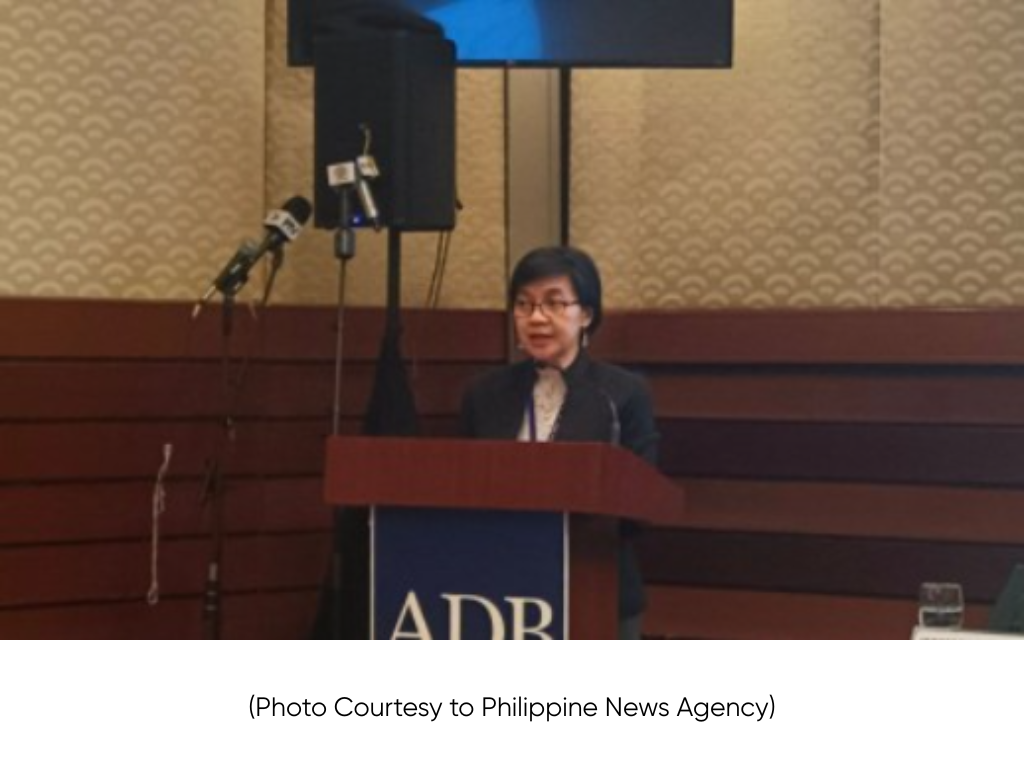
In a briefing, ADB Principal Economics Officer Teresa Mendoza said higher global oil prices have quickly passed through to domestic fuel costs due to the country’s reliance on imports.
The government has rolled out targeted assistance programs, including cash and fuel subsidies, to cushion the impact on vulnerable sectors such as farmers, fisherfolk, and public transport drivers. It has also moved to secure oil supplies from non-Middle East sources.
Inflation is projected to ease to 3.5 percent in 2027.
Moving forward, the ADB underscored the need to strengthen inclusive and quality education, noting that lifelong learning remains a key policy challenge.
Mendoza said targeted education reforms, improved nutrition, and stronger private sector collaboration will be crucial to sustaining long-term, inclusive growth.
"What the current global conditions underscore is really the need for sustained reforms especially in strengthenin,g human capital, improving investment efficiency, and the business environment alongside protecting vulnerable households," she said.
"Regional cooperation will also be important, strengthening, diversifying regional supply chains, deepening engagement with our neighbors can help reinforce or facilitate cross-border trade, investment, and capital flows," Mendoza added.
Asia-Pacific outlook
The ADB said the subdued growth outlook extends across developing Asia and the Pacific.
Most economies in the region are expected to see slower growth in 2026 and 2027, despite resilient private consumption and strong demand for artificial intelligence-related goods.
Growth in the People’s Republic of China is projected to slow to 4.6 percent in 2026 and 4.5 percent in 2027, from 5 percent in 2025, amid continued property market weakness and slower export growth.
India’s economy is forecast to ease to 6.9 percent this year from 7.6 percent in 2025, before accelerating to 7.3 percent in 2027, supported by strong domestic consumption.
Pacific economies are expected to post the sharpest slowdown, with growth declining from 4.2 percent in 2025 to 3.4 percent in 2026 and 3.2 percent in 2027.
After easing in 2025, regional inflation is projected to rise to 3.6 percent this year due to higher energy prices linked to the conflict.
"The two-week ceasefire announced this week provides some optimism, but it appears to be quite fragile at the moment," ADB Senior Economist Jaqueson Galimberti said.
He warned that prolonged disruptions in energy markets could significantly impact the region.
“In a scenario where disruptions persist into early next year, regional growth could be 1.3 percentage points lower over 2026–2027, while inflation could be 3.2 percentage points higher,” he said, adding that risks also stem from US tariff shocks and tighter global financial conditions. (PNA)
 Log in with Google